Category Archives: canada

Cape George Lighthouse

Cape George LighthouseIf you were on a boat near Cape George, Nova Scotia in the mid 1800’s, you couldn’t help but notice the lighthouse. And, if you did, you’d be in a bit of trouble!

In 1861, the first of three lighthouses were built to guide fishing boats around Cape George Point. This first lighthouse was powered with a ten foot diameter iron lantern, with eight sides and cut glass prisms that demanded 120 gallons of oil each year. Glass prisms from the second lighthouse where unique and rare in cut and are on display at the Bluefin Tuna Interpretation Centre, a few minutes down the road at Ballantyne’s Cove wharf.

Cape George waterOver 107 years there were four lightkeepers. From the Condon family (1861) to Alex MacEachern (whose annual salary was $450), Charles Falkenham and finally William Clark (1968), they kept the lighthouse lit 24/7. Today, the lighthouse is automated and unmanned. The grounds are kept well by volunteers and there are a lot of picnic tables to eat your lunch, enjoy the view and snap pictures of St. George’s Bay, PEI and Cape Breton. Interpretive panels are on site to learn more about the history of the area.

To get there, take route 337 which follows the shoreline through small fishing communities overlooking the Northumberland Strait. It’s a beautiful drive.

Area information:

Arisaig: Part of the Mini Cabot Trail

Cape George Lighthouse

The Cape George Hiking Trail offers 33 kilometers of connected loops and linear sections.

Cape to Cape Trail Nova Scotia’s first long distance footpath traveling over 400 kilometers, all the way from Cape Chignecto in Cumberland County to Cape George in Antigonish County. It’s under construction.

Don’t hang up those skates!

Just because we are taking off the winter tires and packing up the winter coat doesn’t mean we can’t still hit the ice.

For the past month, a friend and I have been skating at the Centennial Arena. From 9 p.m. – 11 p.m. for a $4 admission, you can skate 12 months of the year on Sunday nights. No helmets required.

Skating at Centennial ArenaMy skates are old, 23 years old to be exact. They are “figure skates”, for those who can do “figures” I suppose. I guess that explains why I could never really skate with them. My friend just bought a fancy pair, the kind that you turn a dial and the laces are tightened. Go figure.

It is here where you can you listen to Wilf Carter, Charlie Pride and Lady Gaga blaring from the same speakers. There is music to please all age groups in attendance. My friend thinks that the exact same music is playing from when she went there as a kid. “Really?” I said, as I clumsily laced up my rusty blades. Lady Gaga was in diapers when I bought them.

Skating at Centennial ArenaStepping out onto the ice was weird. So used to skating on a bumpy pond surface, it was wonderful and smooth at the arena. Everyone skates in the same direction for about 15 minutes, then switches to the other direction – you can hear people groan as they say “I skate better in the other direction”. The majority of people are just doing their best to stay upright. It’s a happy, fun atmosphere.

In the center ice area members and former members of skating clubs in Halifax look like graceful swans practicing their jumps and spins. It’s nice to watch them as you take a rest in the stands. They give figure skates their name.

Skating among the pack are a few people with yellow arm bands. I wondered if they were members of a singles club but I later learned that they were security. They are good and fast skaters too.

Once in awhile you’ll hear a yelp from someone who wiped out and then bashfully stands up, brushes themselves off and then starts again. It’s common. It’s perfectly okay. I know because every time I’ve gone, I’ve wiped out (except last time but we didn’t stay the entire 2 hours either). One time I wiped out just after the Zamboni cleaned the ice at the halfway mark. I was wearing grey leggings, not a good idea. I not only “advertised” that I wiped out but I was soggy the rest of the skate. The next week, I wore black.

See you on the ice…in July and August!

Here’s more info:

Centennial Arena is located in Halifax, 27 Vimy Ave.

Here are directions

For more information, call Jack at 490-4926

Joe’s Scarecrows Roadside Attraction

Joe's Scarecrows, near CheticampSo here we were driving along outside Cheticamp, glancing back once in awhile to say good-bye to the mountains in the distance when out of the blue, we see scarecrows. Lots of them. They were hilarious! We actually had to turn around because they demanded our attention.

The place was Joe’s Scarecrows just 10 minutes outside Cheticamp in a community called St-Joseph-du-Moine. Here you can meet members of the royal family, political figures, music stars etc They all are dressed up with a caption written on a piece of cardboard that introduces who they are and their name.

There is a table with a donation box set up so you could help the owners dress for next year. Nearby you can buy a burger, fish & chips, meat pies, ice-cream and home made pastries.

Joe's ScarecrowsJoe Delaney originated Joe’s Scarecrows.Mr. Delaney, who passed away in 1996, enjoyed a good laugh. The story of how it all began was back in the mid 1980’s when Mr. Delaney put up scarecrows to keep crows from eating vegetables in his garden. Joe, being a huge fan of Mi-Carême , put up two scarecrows dressed in funny costumes and masks. Right away, this created a road-side attraction that just kept getting bigger. I imagine the idea of having a garden was scrapped because I didn’t notice a garden (then gain, I was distracted).

Joe's ScarecrowsMi-Carême literally means the middle of Lent; the third Thursday of the forty days of fasting and penance before Easter. This day was reserved to give everyone the opportunity to celebrate and escape their Lenten duties. Brought to North America by French settlers, la Mi-Carême has survived in only four Canadian villages. For over 200 years, this celebration has been kept so strong in the Chéticamp, St-Joseph-du-Moine and Margaree region that instead of one day, people of this area have made it last a whole week.

Today, his family carry on the tradition of dressing up the scarecrows for the thousands of visitors every year who stumble upon the attraction.

Information on Joe Delaney

See more pictures from Joe’s Scarecrows on The Right Coast NS’s Flickr web album

Map location of St-Joseph-du-Moine

Broad Cove Campground – Cape Breton Highlands

It was 8:20 p.m. when we pulled into campsite #189. We were in Broad Cove and it was the first night of our three day tour of Cape Breton.

Cabot TrailMinutes earlier we entered the Cape Breton Highlands Park and paid our family rate (2 adults, 2 kids) of $19.60 / day at the ticket gate. After driving about five minutes, we arrived at the gate for Broad Cove campground where we were pleased that they had one campsite left but (to our kids disappointment) there was no fire pit.

The light was beginning to fade so we quickly set up camp and ate dinner. After quick showers, we crawled into our sleeping bags. No reason to stay up because there was no fire to watch- the kids made sure that we took note of this.

Somewhere between the woodpeckers and the crows my REM sleep was interrupted. I generally don’t mind crows but a nylon tent does not make a great sound buffer.

Fishing at Broad Cove BeachBefore packing up to leave we walked down the beach where the kids played in a brook that flowed into a beach. The beach had a couple broken up lobster traps that were left over from a storm. Nearby a man wearing waders fished for mackerel and trout from the beach.

My husband headed back to the campsite while the kids and I explored the brook and beach. When we returned, everything was packed up and we were ready to go. This was awesome and the kids and I planned this perfectly 😉

Broad Cove BeachNext stop? Many. It was the Cabot Trail and who knew what what around the corner.

See photos from our Cape Breton trip on Flickr

For more information:

Cape Breton Highlands National Park of Canada

Information on Broad Cove and other campsites in the park

Back to the Future at Fortress of Louisbourg

IMG_4224On a foggy day in Cape Breton, my family and I stepped back in time to the year 1744. Actually, we drove there – to Louisbourg. After parking the car we went to the Parks Canada info centre where we jumped on a bus that took us to the largest re-constructed 18th century town in North America. Our curiosity was piqued on the bus ride for what was beyond the fog and then the town slowly appeared into view.

At the gate, we were greeted by an armed soldier who questioned the intention of our visit. This playful interpreter asked us what was the purpose of our trip, if we were English or French, even if we were spies (I’ll never tell). Fortress LouisbourgI still think my daughter thought the soldier was serious.

Once on the other side of the gate of the fortress, it was clear that you could spend a day at this impressive site. Friendly costumed interpreters smiled for pictures or said hello as they walked by. They also welcomed onlookers to watch them do tasks such as making fishing nets.

In 1744, the fortress was an important seaport for France. A thriving fishing industry and trade made Louisbourg a stronghold in what is now Atlantic Canada. At that time the soldiers’ rations over four days were: 4 oz of salt fish, 4 oz of vegetables, and 6 pounds of bread. Fortress Louisbourg National Historic SiteThese men worked a 24 hour watch (usually without any sleep) and then had 48 hours off. During their free time they’d hunt or fish (probably for more food :)) As many of the soldiers were criminals, Louisbourg was a lot better than prison in France. To these men, life as a soldier was better than prison. At least as soldier they had a roof over their head and food to eat. If they stepped out of line, they had to sit on a wooden horse with their hands tied and sacks tied to their legs. This was a form of humiliation because they’d be in clear view of everyone.

By 1760, Louisbourg lay in English hands and its fortification, destroyed. Fortunately, the French were meticulous record keepers because when the fortress was being re-constructed beginning in the 1960’s, there were 750,000 documents to sift through. The re-construction was a massive undertaking which included archeological digs etc to re-build everything as a carbon-copy of the original. Cape Breton miners were enlisted in the project for their valuable skills.

IMG_4243It was time well spent in this 18th century town. By late afternoon we had to jump into the car and set up camp in Broad Cove but we all said we’d like to go visit again someday.

See more pictures of Fortress of Louisbourg on Flickr.

Related links:
Fortress of Louisbourg National Historic Site
The Louisbourg Institute of / L’ Institut de Louisbourg de Cape Breton University
Destination Cape Breton
Novascotia.com History comes alive

How to pick mussels

Important!

Check before you dig! Make sure the area where you plan to harvest shellfish is open. When an area is officially “closed,” it is both illegal and unsafe to harvest shellfish from that area.

Check for shellfish harvesting closures.

————

There are many places along the coast of Nova Scotia to pick your very own mussels.

Growing up along the Eastern Shore of Nova Scotia, picking mussels was one of my favourite pastimes. Some like to keep their mussel patches secret. One wouldn’t want to give away too good of a good thing right? So I’ll explain the “how to”, for now.

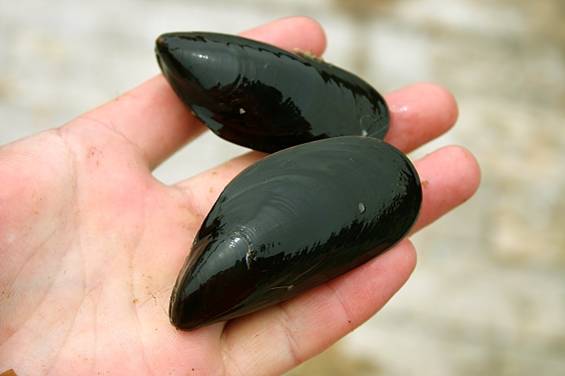
Blue mussels can be found in cold and warm waters all over the world, however many of them are found along the coast of Nova Scotia. They are a member of the clam family and are somewhat similar in appearance-except for the blue-black coloring.

Mussels can be picked at low tide. Unlike clams, they grow above the sand amongst seaweed around rocks. One can tell that mussels are in the area by noticing how many empty mussel sheets are lying around. If there are lots of empty shells, then walk to the waters edge, move aside the seaweed around the rocks, and have a look. There is no need to remove the seaweed, it generally stays where you want it to stay. Rocks can be slippery so be careful. If you notice a cluster of mussels, grab one and tug (they can attached themselves firmly to a rock).

In summer-time, mussels’ capacity to filter small particles makes them accumulators of the deadly red tide organism, Gonyaulax. Please check with the Nova Scotia Department of Fisheries and Aquaculture before mussel picking to make sure your area is safe: aquaculture@gov.ns.ca. Don’t plan on pickin’ until you get the thumbs up!

Once picked, take your bounty home. Wash them well in the sink with cold water and gently tap two together at a time.  If they stay tightly closed, they are good to eat. Discard the ones that don’t close and stay open. Now, try this fabulous recipe.

The difference in colour of the meat has nothing to do with a difference in taste. I’m told that the orange meat is a mature female mussel, whilst the pale cream meat mussels are males (or immature females). Yummy.

Blue mussell photo is Courtesy of Sean MacNeill.

Here’s a yummy Curry Cream Mussel recipe

A & K Lick-A-Chick

A&K Lick-A-ChickIn Bras D’Or (outside Sydney) is a restaurant called A&K Lick-A-Chick. After hearing about this place as the “best tasting fried chicken on the island”, we just had to stop in for a bite.

It was lunch time and judging by the number of people waiting in line, my husband and I knew we were in for a bit of a wait. We found a booth and with ticket stub in hand we passed the time listening to the locals, looking at the merchandise (taking note of the hats in individual plastic bags over the counter) and watching the traffic rush by. When our number was called, my husband and kids had to wait another 10 seconds while I took a picture of our delicious crispy chicken and fries. Then we ate like beasts from an episode of “Wild Kingdom.”

IMG_4198This place is such an icon that there are over 4300 fans on Facebook. A discussion item on the fan page asks “what is your favourite menu item” and it appears to be a toss-up between the 3 piece chicken dinner and the chicken fingers. A person named Sha wrote that “chickens don’t have fingers.”

After a satisfying lunch, we were back in the car and on our way to Louisbourg. Thinking that we should’ve drove across the street to Lick-A-Treat for an ice cream but, then again, we had one earlier that day in Baddeck.

Directions to A&K Lick-A-Chick.

See more pictures from our visit on Flickr

Ferry Boat Tales

Ferry Tales 038A few weeks ago I met up with a girlfriend for lunch. She works in Dartmouth and I work in Halifax so I agreed to hop on the 12:15 ferry from Halifax to meet her at Alderney Landing in Dartmouth. I had read about a new summer program on the Metro Transit ferry system where actors tell tales of Halifax’s rich seafaring history.

Ferry Tales 030 So, on a Tuesday afternoon I paid $2.25 (made sure I got a transfer ticket for the trip back) and caught a Dartmouth-bound ferry. It was a beautiful sunny day so I sat on the top deck to soak in the view and the rays. Minutes after leaving dock, out jumps Jack Tar and his friends. Jumping from seat to seat and telling a story about a battle near Sambro, ferry passengers (once the surprise settled in) soon realized that they were in the middle of an reenactment.

Ferry Tales 027Here we were, in the middle of Halifax Harbour receiving an entertaining history lesson where the harbour itself has been the topic of text books, movies, conversation and so on. Another cool thing was traveling on the oldest salt water ferry service in North America.

It was perfectly choreographed and the length of the story was the exact length of the ferry ride. I didn’t want it to end but I knew my friend was waiting for me and I was hungry.

Ferry Boat Tales is presented by the Halifax Regional Municipality in association with Maritime Museum of the Atlantic. Produced by Heritage Explorers and performed by DaPoPo Theatre.

If you go:
July-August – Tuesday to Saturday

To Dartmouth
(Halifax waterfront at the foot of George Street)

12:15 pm 2:15 pm 7:15 pm

To Halifax
(Dartmouth waterfront at Alderney Landing)
12:30 pm 2:30 pm 7:30 pm

Free with transit fare: $2.25 Adult; $1.50 Senior/Child

See more pictures on The Right Coast Nova Scotia’s new Flickr account.

The Whirlygig Factory

Whirligig.

Isn’t it fun to pronounce? Besides that, they are also fun to look at. When you are driving along the Lighthouse Route between Mahone Bay and Chester, you can’t help but notice the flurry of whirligig’s at The Whirlygig Factory. So many that they’ll make your head spin.

As I type, I can’t help but wonder why my spell check is picking up whirlygig with a “y”. I’ll come back to that later but first, what is a whirligig?

Wikipedia describes a whirligig as “wind-powered hanging art”- big contrast for what they were used for in ancient times as spinning torture devices. Now these lawn and garden ornaments is considered folk art. A visit to The Whirlygig Factory is where you can get your fix of these quirky and fun ornaments.

It was here where I met Barry and Kara Coutts, owners and creators everything whirligigish. They’ll custom make your piece or choose from many designs either on display or on their website.

When I arrived, Barry was the first person I met. Busy in his workshop, he was working on one of his “Tit-il-ating Mermaids”. These lovely ladies make you giggle at first and then you realize that these beauties are works of art. Found throughout the property reading in hammocks or playfully posing in a flower garden. It takes 400 feet of copper wire to make the hair, 5 hours to strip the wire and fashion it to the head. Their jewelery are fashioned from glass beads and sea shells.

The Turner Collection was inspired by Bunny & Pat Turner of Nova Scotia who wanted an old traditional whirligig reproduced. Barry was then motivated to create their own line of true “folk” whirlygigs, the one pictured here is “Musher”. Also part of the collection is “Harvey the Hunter”, “Wanda the Wash Lady”, “Charlie the Chopper”, “Peggy the Pump Lady” – all wind powered, colourful and entertaining.

As to why there is a difference between whirlygig and whirligig? A quick phone call to Kara said it’s merely for phonetic reasons because that’s how most people would spell it.

Helpful information:

Location of The Whirlygig Factory

The 10th Annual Whirligig & Weathervane Festival September 19 & 20, 2009 in Shelburne, NS

The South Shore region

The <a href="http://novascotia.com/en/home/planatrip/gettingaround/scenic_travelways/lighthouse_route/default.aspx"target="blank

“>Lighthouse Route

Pink Lady’s Slippers: To pick or not to pick

There is a trail behind our house and recently I discovered various patches of Lady’s Slippers. Actually, it was a woman taking a picture of these flowers that first caught my eye.

What are these puffed up flowers all about? Well, here are a few interesting facts:

– they are a wild orchid (Cypripedium acaule)
– also known as the moccasin flower
– can cause severe dermatitis if touched
– it’s the provincial flower of Prince Edward Island, since 1965
– it is the only flower with a lip (slipper)
– they prefer poor, acid soils (around pH 4-5) and do best in light to moderate shade.
– growth is slow, and it may take several years to flower
– they are fragile and do not transplant well, in fact, it’s discouraged
– should not be picked or used in floral arrangements

People tell me that information about Nova Scotia’s conservation of the Lady’s Slipper is available but I cannot seem to find anything. Send a comment if you know and I’ll happily post it.